Data Standards
Definitions
Plate: the metal or stone surface on which a printable image is prepared
Print: a general term for impressions from a specific plate
Impression: an individual piece of paper with the image printed from the plate
State: the plate in a significantly different condition (deliberately or accidentally) from which an impression has been taken.
Designations
Numbering: The number used for each print follows Rawlinson's lists. Unfortunately he created two lists starting at 1. The list for the Liber Studiorum prints are prefixed by F (from Finberg 1923) e.g. F068 (Isis). This list for all other prints are prefixed by R (from Rawlinson 1908 and 1913) e.g. R068 (Newbury from Speen Hill).
After Rawlinson finished his numbered list, he discovered more prints. In order to accommodate these, he shoehorned the new prints into an appropriate place by adding an "a" etc suffix, e.g. R832c (Linlithgow Palace). We have continued that practice e.g. R346b (Castle of St Angelo).
After Turner's death, copies of published and unpublished pictures were created, particularly of the Liber Studiorum but also others. Those produced by Lupton have been given the suffix "L" e.g. F044L (Calm) , and those by Short "S" e.g. F044S (Calm), though the many by Durjadin et al from the later C19th have not yet been included. One major print by Haden, S141 (Calais Pier) has also been added to the list.
States: States are usually divided into: etchings, etc; engraver's proofs, ep; published states, i. Drawing demarcation lines were and can be uncertain as the definition of "proof" varies considerably with commercial pressures. Frequently impressions of etchings were included with the commercial sale of the "finished" print, and "proofs" (undefined) were advertised for sale. Each of these divisions may have multiple states, e.g. etc2, epb, ii. Even in Rawlinson's day, identifying and cataloguing all the states was not possible. It is hoped that this catalogue will promote increased clarification.
Publication page
The majority of Turner's prints were published in series of parts which were eventually made up into a book, though many of the larger prints were published and available singly. Rawlinson's publication list is arbitary and is used for convenience.
The page for each publication has two main sections. First is a selection of contemporary advertisements and publishing data. Next is the list of Turner's prints in the original publication.
The indexing image for each print is usually of an impression of the first published state. Where the print was never published, the latest available state is used. Where no digital image of a first published state is yet available, an image of the closest state is shown.
Clicking on a print image or label opens up a list of images of states currently available as iiif pyramids for that print.
Print page
This page aims to illustrate the progressive states of the print. The ordering is based on what Rawlinson or Finberg described, with the progress of states illustrated from collections which have made high resolution digital copies available. However where further states or data have been identified, these have resulted in a revision of that ordering.
States which are illustrated using an off-site institutional impression can be viewed by clicking on "Click for external image", while its metadata can be seen by clicking on the state label.
States for which a high resolution image is available on-site are shown with an image. Either that or its label can be clicked to view the page of image with metadata.
State page
Either on this or an institution's site, it should be possible to zoom the image to see fine detail - we are aiming to show the individual lines and dots resolved on each impression. The image provided of the impression has been trimmed to the plate mark.
The metadata fields are largely self explanatory.
The Engraver entry is based on Rawlinson’s declared engraver, supplemented by later scholarship.
The Catalogue Link provides a link to an online version of the relevant catalogue.
The Changes to States summarises any amendments to the published lists.
Impression data lists the physical data and owner's reference for the impression. Sizes are given height x width in mm.
Text on impression is a transcription of the printed marks.
Inscriptions detail any manuscript annotations or comments.
Collection marks: A common addition is the blind stamp, TS{L.1498}, applied to the bottom right of the image line when sold in the 1870s Christie sales. The number is derived from Frits Lugt, Les Marques de collections de dessins & d’estampes and similar numbers indicate other collectors' marks.
Comments on these transcripts are in curly brackets {..} and relate usually to the type of script used or position, though {wal} in the title field indicates no printed lettering is seen on the impression. The symbol ¦ indicates a new line within a text.
Notes about the impression and additional context information are provided where possible.
The image data provides references to the original image used to generate the iiif pyramid and its status.
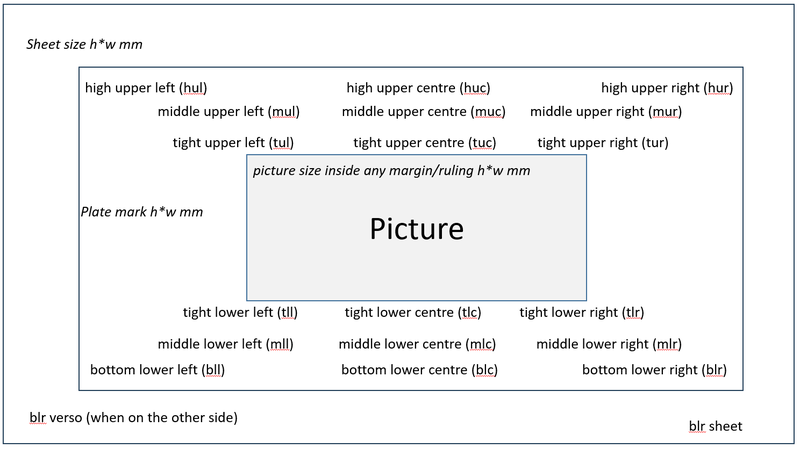
The reported Position on the sheet is related to the picture position as shown below but is an approximation. The actual position needs to be checked on the image.